Cosmetic products sold in the UK, EU and US must carry a full ingredient list, and legislation requires that list in a very specific format. The format is the INCI list, and getting it wrong is one of the most common reasons cosmetic products are delayed at launch, rejected by retailers or flagged at borders.
This guide explains how to create an INCI list consistent with the UK Cosmetics Regulation (retained Regulation (EC) No 1223/2009, as amended), EU Regulation (EC) No 1223/2009 and US FDA labelling rules, how the requirements differ between markets, and the errors that most often hold products up at artwork approval, retailer audit or customs.
What is an INCI list?
INCI stands for International Nomenclature of Cosmetic Ingredients: a standardised naming system used worldwide to identify cosmetic ingredients on product labels.
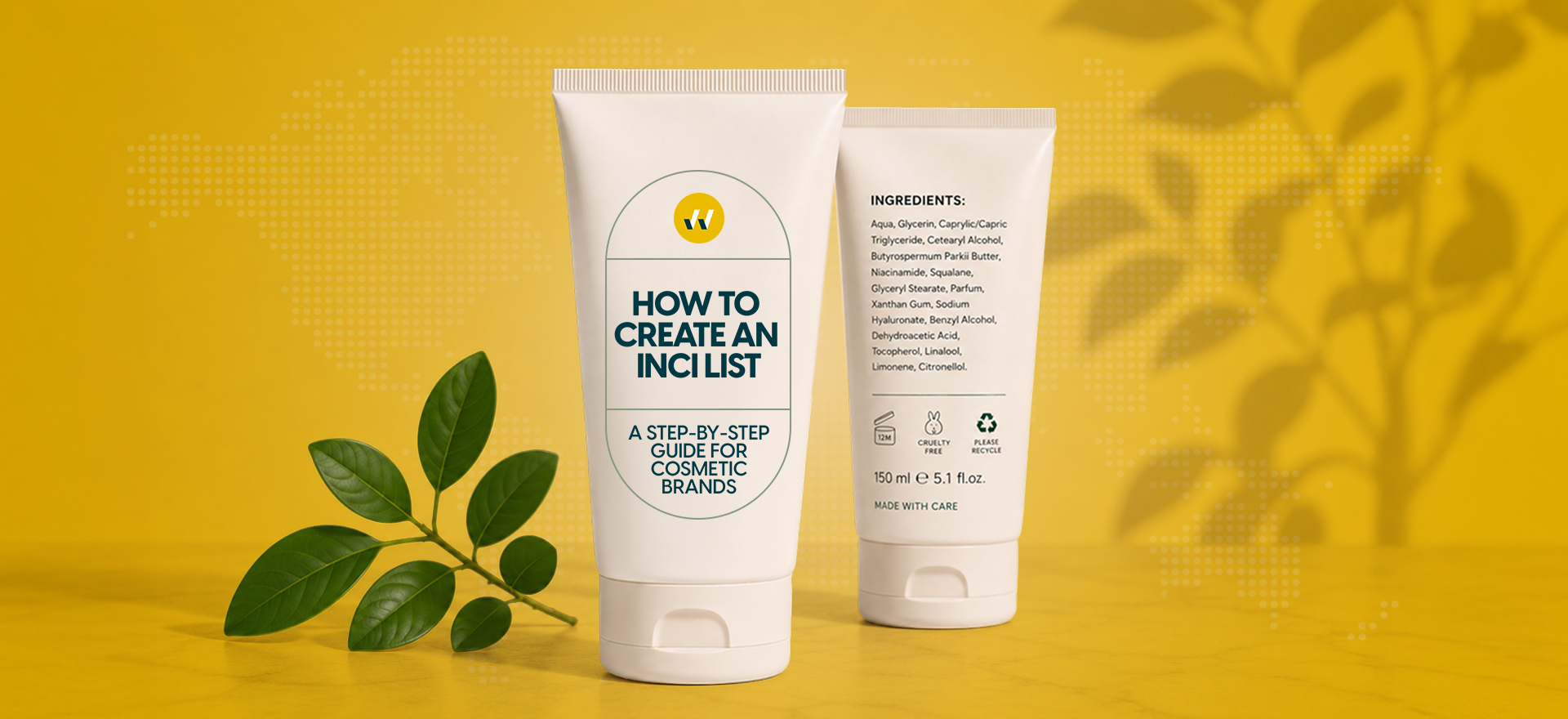
An INCI list is the ingredient declaration on your packaging, written using these standardised names and ordered according to the rules of each market where you sell.
The system exists so that a consumer, dermatologist or enforcement officer can read any label, in any country, and know exactly what the product contains. So while your packaging front can promote shea butter, for example, the ingredient list must call it Butyrospermum Parkii Butter in the UK and EU and Butyrospermum Parkii (Shea) Butter in the US.
How to create an INCI list
Step 1: Gather complete formulation data
You cannot write a correct INCI list from a marketing description of your formula. You need enough compositional information to identify each ingredient, work out where it falls in the order of declaration, and check its concentration against any labelling thresholds. In most cases, that means details of every raw material and a full breakdown of every blended or multi-constituent material your suppliers provide.
This last point catches many brands out. A raw material that arrives as a single item on your supplier's invoice — say, a preservative blend, or a botanical extract supplied in a carrier oil — is several substances for labelling purposes, and each one needs to be identified and declared in its own right.
Request full ingredient breakdowns and allergen declarations from every supplier before you start, and confirm the percentages refer to the material as added at the time of manufacture.
“My advice to any brand compiling an INCI list is to put as much attention into supplier documentation as into the label itself. An incomplete ingredient breakdown will produce a declaration that passes a glance but won't withstand scrutiny, and the cost of correcting it after production is far higher than getting it right at the start.”
Dave Hoogakker, Director & Co-Founder, Hooley Brown
Step 2: Assign an accurate INCI name to every ingredient
Once you know what is in the product, each substance needs its official INCI name. For the UK and EU, the source to work from is the European Commission's CosIng database, which lists recognised INCI names and also shows any restrictions, maximum permitted concentrations and annex listings that apply to each substance.
In the USA, ingredient names follow the conventions set out in 21 CFR 701.3, which draw primarily on the International Cosmetic Ingredient Dictionary and Handbook — these frequently, though not universally, correspond with INCI nomenclature. Two categories in particular diverge: botanicals and colourants, both of which are named differently on a US label than on a UK or EU one.
Beneath the databases themselves, INCI naming follows a set of conventions worth knowing before you start matching ingredients to names, as this is where labels most often deviate from the required format:
- Trade names, brand names and chemical aliases should not be used in the ingredient declaration. Labels should use the recognised ingredient names required for the market where the product is sold.
- Botanical ingredients use their Latin binomial name, often with the plant part and preparation — for example, Rosa Damascena Flower Oil — in the UK and EU. In the US (and in some cases Canada), the botanical's common name must also be declared, alongside the Latin name, giving a dual declaration e.g. Rosa Damascena (Damask Rose) Flower Oil.
- Colourants are declared by their Colour Index number, such as CI 77491, in the UK and EU. In the US, the FDA's colour additive name must be used instead, e.g. Iron Oxides in the case of CI 77491. A dual declaration naming both can apply where a single label is intended to serve multiple markets.
- Water is Aqua in the EU and UK; in the US it appears as Water.
Step 3: Order the ingredients correctly
Ingredient order is where most formatting errors occur. Under Article 19 of the EU Cosmetics Regulation (mirrored in the UK Cosmetics Regulation), ingredients must be listed in descending order of weight as added at the time of manufacture.
Ingredients present at concentrations below 1% may then be listed in any order after those above 1%. Colourants may be grouped at the end of the list in any order, and for decorative cosmetics sold in a range of shades, all colourants used across the range may be listed together, preceded by “may contain” or the +/- symbol.
The USA follows a similar logic under 21 CFR 701.3: ingredients above 1% in descending order of predominance, ingredients at 1% or less in any order after that, and colour additives grouped at the end.
The order reflects concentrations as ingredients are added, so materials supplied in dilution are declared at the strength that goes into the vessel. And since anything below 1% can appear in any order, there is no need to list those ingredients by their true concentrations — doing so tells competitors more about your quantities than the law requires you to disclose.
Step 4: Declare fragrance and allergens
Fragrance compositions are declared collectively as Parfum (or Aroma for flavourings) in the UK and EU, and as Fragrance or Flavor in the US. However, in the UK and EU, specific fragrance allergens must also be named individually in the ingredient list when they exceed 0.001% in leave-on products or 0.01% in rinse-off products.
Fragrance allergen declarations should be assessed in the finished cosmetic product, taking account of the concentration of the fragrance used in the formulation.
Commission Regulation (EU) 2023/1545 has expanded the list of declarable fragrance allergens from 26 to more than 80 substances. As a result, cosmetic products placed on the EU market from 31st July 2026 must comply with the expanded list, and products already on the market must comply by 31st July 2028. At the time of writing, the UK has retained the original 26-allergen list and has not yet adopted the expanded EU list, which may impact a single label strategy.
Read more on EU fragrance allergen labelling changes.
If your artwork, Product Information File and supplier allergen declarations have not been reviewed against the new EU list, that work should be underway now, given the lead times involved in relabelling.
Step 5: Apply the special cases
A handful of additional rules apply to cosmetic ingredient labelling in the UK and EU. For example, ingredients present in nanomaterial form must be followed by the word “nano” in brackets.
Additionally, certain substances listed in the annexes of the Cosmetics Regulation trigger mandatory warnings alongside the ingredient list itself. And the list must be preceded by the word “Ingredients” and appear on the packaging in accordance with Article 19, with limited exceptions for very small packs where alternative formats such as a leaflet or tie-on tag are permitted.
How INCI requirements differ by market
The UK, EU and US share the same broad structure, but there are differences in the detail as we’ve already shared: Aqua versus Water, Parfum versus Fragrance, CI numbers versus FDA colour additive names, and Latin-only botanical names versus the Latin-plus-common-name format the US requires.
US obligations also extend beyond the ingredient declaration itself. The Modernization of Cosmetics Regulation Act (MoCRA) introduced additional regulatory requirements, including facility registration and product listing.
Selling in multiple markets means either producing market-specific labels or engineering a single label that satisfies every regime, and both routes need specialist review. Botanicals and colourants are usually the point at which a single-label approach becomes difficult, because the naming itself differs rather than just the wording around it.
Common INCI list mistakes that cause delays
Across markets, the same INCI labelling errors come up repeatedly. These include:
- Using trade or marketing names instead of INCI names
- Ordering ingredients by the supplier's recipe sheet rather than the finished product percentages
- Failing to declare the individual ingredients within blended raw materials and fragrance compositions where required
- Missing allergen callouts because supplier documentation was incomplete
- Declaring colourants without CI numbers for the UK and EU, or without the FDA colour additive name for the USA
- Omitting the common name from botanical ingredients on US labels
- Reusing one label across markets without checking naming conventions and allergen requirements for each
Any one of these can mean rejected artwork, a failed retailer audit, a product held in customs or a costly recall and relabel.
There is also a commercial cost to getting it wrong. Retail buyers increasingly review ingredient labels before listing a product, and an inaccurate INCI list undermines every claim on the pack.
Get your INCI lists right first time
An accurate INCI list depends on complete and up-to-date supplier data, current regulatory knowledge across every market you sell in, and careful checking at artwork stage. That combination of knowledge is difficult to maintain in-house while you are also developing products and growing distribution.
Hooley Brown supports cosmetic brands and manufacturers with ingredient labelling, artwork compliance checks and market-specific regulatory requirements across the UK, EU, US and further afield.
Whether you are preparing your first product for launch, reviewing your products against changing legislation or expanding into new export markets, our team helps ensure your INCI lists and wider labelling meet applicable regulatory requirements and are ready for market.
Talk to us about your cosmetic labelling requirements and take ingredient compliance off your to-do list
This article was published in September 2026. Regulations, standards and enforcement guidance can change. Always verify current requirements and seek professional advice for your specific situation.