If you manufacture, import or distribute paddling pools, swim rings, or other outdoor play equipment or pool accessories into the EU, the General Product Safety Regulation (GPSR) applies to your products.
But GPSR is only one of several legal frameworks that may apply, as many products also fall under the Toy Safety Directive alongside other applicable EU legislation.
In this article, we cover which outdoor toys and play equipment are covered by GPSR, and how manufacturers, importers, distributors and sellers can comply with GPSR rules.
Which outdoor toys and leisure products fall under GPSR?
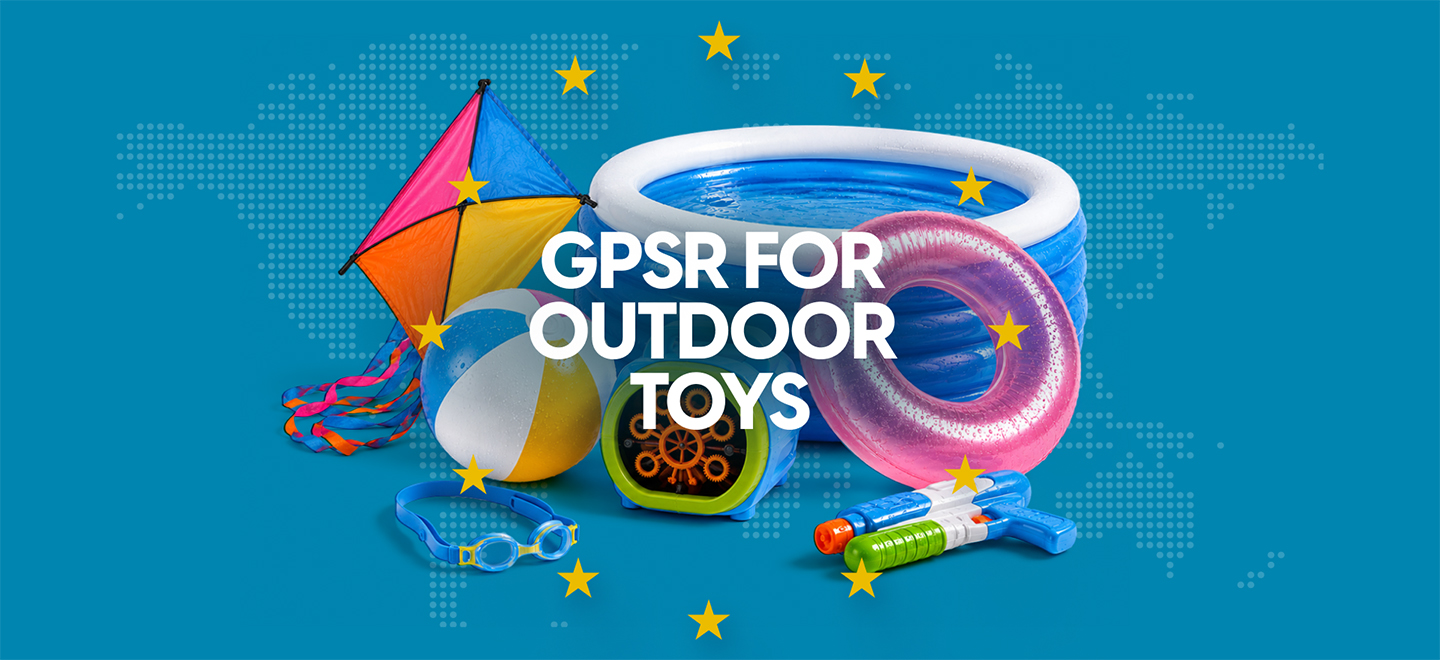
Water and pool products that fall within the scope of GPSR include paddling pools (rigid, inflatable and pop-up), inflatable swim rings, armbands, pool floats, water slides, splash pads, dive sticks, pool noodles and garden sprinklers marketed as play items.
Then there's outdoor play equipment: swings and swing sets, slides, climbing frames, garden trampolines, playhouses, sandpits and seesaws. Plus a broader group of outdoor accessories, including bubble machines, water guns, kites, croquet sets and skipping ropes.
Other EU regulations that apply to outdoor toys and leisure products
Most outdoor toys and play equipment are subject to at least one other EU framework alongside GPSR. Depending on your product range, these may include:
- Toy Safety Directive: applies to products designed or intended for play by children under 14. The EU has also adopted a new Toy Safety Regulation, which will replace the Directive following a transition period and introduces stricter requirements, including expanded restrictions on certain hazardous chemicals.
- REACH: governs chemicals in products and is relevant for PVC content in inflatables, phthalate restrictions, coatings and surface treatments on metal components, and rubber or foam elements. REACH obligations apply regardless of whether a product is classified as a toy.
- PPE Regulation: may apply where an inflatable swim ring, armband or similar product is intended to provide protection against drowning or another safety function (and marketed as such). Products within the scope of the PPE Regulation follow their own conformity assessment and CE marking requirements.
- Packaging and Packaging Waste Regulation (PPWR) applies to all packaged consumer products and includes extended producer responsibility obligations in most EU Member States.
Is it a toy? How the Toy Safety Directive and GPSR overlap
Research by EU authorities and consumer organisations has repeatedly identified non-compliant toys being sold through online marketplaces.
Before you can work out your GPSR obligations, you need to establish whether each product in your range is classified as a toy under the EU Toy Safety Directive. The distinction often comes down to marketing, packaging and intended use rather than the physical product itself.
Paddling pools are a useful illustration. A small inflatable pool with colourful children's graphics, packaged and marketed for kids, will almost certainly be classified as a toy and will normally be tested against the relevant parts of EN 71 to demonstrate compliance with the Toy Safety Directive. A larger pool marketed as a “family garden pool” without age-specific targeting may sit outside the Toy Safety Directive, but still fall under GPSR as a general consumer product.
Swim rings and inflatables raise a similar issue. A swim ring packaged as a toy will normally be assessed against the relevant parts of EN 71 to demonstrate compliance with the Toy Safety Directive. However, a novelty pool float marketed to adults will not. If a swim ring or armband is intended and marketed as providing protection against drowning, it may instead fall within the scope of the PPE Regulation, which is an entirely separate compliance pathway with its own conformity assessment.
Trampolines are another product where classification depends heavily on context. A garden trampoline designed for children can fall under EN 71-14 (trampolines for domestic use classified as toys). But a trampoline intended for gymnastic training falls under EN 13219, the European standard for gymnastic trampolines. Equipment installed in a public playground or communal setting may need to comply with EN 1176, the European standard series for permanently installed public playground equipment and surfacing. In each case, the applicable regulatory framework changes depending on intended use, user age group and where the product is installed.
“We often work with businesses that have been selling outdoor products for years without having fully resolved the classification question. They've assumed a product is or isn't a toy based on how they think of it internally, rather than how the regulations define it. That assumption then feeds through into their technical file, their labelling and their standards selection, and when it's wrong, unpicking it is expensive and time-consuming.”
— Chris Giddings, Product Compliance Specialist, Hooley Brown
Safety risks that GPSR requires you to address
Article 9 of GPSR requires manufacturers to carry out an internal risk analysis before placing a product on the EU market. This analysis needs to cover the product's characteristics, its intended and reasonably foreseeable use, and the consumers likely to use it — including vulnerable groups such as children and older people.
For outdoor toys and leisure products, the risk profile has some distinctive features that set this category apart:
Drowning and water safety
Paddling pools, swim rings and inflatables all involve the use of water, and drowning remains one of the leading causes of accidental death in young children across Europe. Your risk assessment for any water product needs to address supervision requirements, water depth and capacity, the risk of a child gaining unsupervised access to a filled pool, and — for inflatable rings and armbands — the danger of the product being mistaken for a life-saving buoyancy aid when it isn't one.
Article 6 of GPSR requires reasonably foreseeable use and misuse to be considered when assessing product safety, making it directly relevant here. The instructions and warnings accompanying these products should therefore address water safety explicitly.
Structural integrity under dynamic loading
Equipment like swings, climbing frames, slides and trampolines bear the weight of children (and sometimes adults) in motion. Potential failure modes include weld fracture, joint fatigue from repeated stress, fastener loosening, and frame distortion over time. Maximum user weight ratings need to be tested, documented and communicated clearly — both on the product itself and in the instructions.
Material degradation over the product's lifespan
Some play equipment spends months outdoors, exposed to UV rays, rain, temperature swings and frost. Metal play equipment corrodes, fabric and rope elements lose tensile strength under prolonged UV exposure, and a PVC paddling pool may become brittle after a winter in a garden shed. Your risk assessment should cover the product's expected condition across its lifespan, not only at the point of sale.
Chemical risks
This category centres on PVC-based inflatables and coated metal components. Phthalate content in flexible PVC, lead or cadmium in pigments, and surface treatments on metal frames all carry potential chemical hazards. These risks fall under both GPSR's general safety requirement and REACH obligations.
Entrapment and entanglement
Trampoline enclosures, swing chain links, climbing frame apertures and gaps between slide components all require assessment against entrapment criteria. The EN 71 and EN 1176 series include detailed dimensional requirements on this point, and they're a useful reference even where GPSR is the primary framework.
Small parts in mixed-age settings
Many outdoor toys are used in domestic gardens where children of different ages play together. A valve cap on an inflatable or a small accessory may present a choking hazard to a younger sibling if the product is designed for older children. GPSR requires you to consider the categories of consumers likely to use the product, and in a household context, that includes younger children who aren't the intended user.
All of these risk assessments must be formally documented and held in the product's technical file.
GPSR obligations for manufacturers, importers, distributors and online sellers of outdoor toys
Manufacturers
Before placing a product on the EU market, manufacturers need to carry out an internal risk analysis and compile technical documentation covering the product description, identified risks, mitigation measures, test reports and the European standards applied.
Every product must also carry a type, batch or serial number visible to the consumer, along with your business name and both postal and electronic contact details.
Manufacturers based outside the EU must appoint an EU Authorised Representative, whose details need to appear on or with the product.
Safety instructions must be provided in the language(s) of each Member State where the product is sold. You're also required to report dangerous products through the Safety Business Gateway, establish procedures for handling consumer complaints, keep a register of complaints where appropriate, and maintain records of recalls and corrective measures.
Importers
Importers must take appropriate steps to verify that these obligations have been fulfilled. Simply relying on assurances from the manufacturer may not be sufficient where there are reasons to question compliance.
You'll also need to add your own contact details to the product or packaging, confirm instructions are in the right language for each market, retain technical documentation for 10 years, and maintain supply chain traceability records for at least six years.
If an imported product turns out to be dangerous, you must withdraw it immediately and notify authorities, whether or not the manufacturer cooperates.
Distributors
Distributors need to verify that products carry the required identification markings, manufacturer details, and safety instructions in the correct language(s) before making them available. You shouldn't list a product if there's reason to believe it's non-compliant.
Online and marketplace sellers
A large proportion of outdoor toys are sold through Amazon, eBay and similar platforms. GPSR applies in full to distance selling, so every listing must display:
- The manufacturer's name and contact details
- The EU Authorised Representative's details (where applicable)
- Sufficient product identification (typically including a product photograph)
- Any relevant warnings in a language consumers in the target market can understand
Providers of online marketplaces also have obligations under GPSR, including registration with the Safety Gate Portal and cooperating with authorities to remove dangerous product listings.
Not sure where your products stand?
If you're selling outdoor toys and leisure products in Europe and you're unsure whether your range is fully compliant with local legislation, Hooley Brown can help.
We strengthen companies’ regulatory position where frameworks like GPSR, the Toy Safety Directive, REACH and PPE Regulation impact the same product range. We can also act as your EU Authorised Representative, supporting technical file development and labelling review, and advise on how to get compliance right before products reach the market.
Book a free discovery call or email hello@hooleybrown.com to get started.
This article was published in July 2026. Regulations can change. Always verify current requirements and seek professional advice for your specific situation.