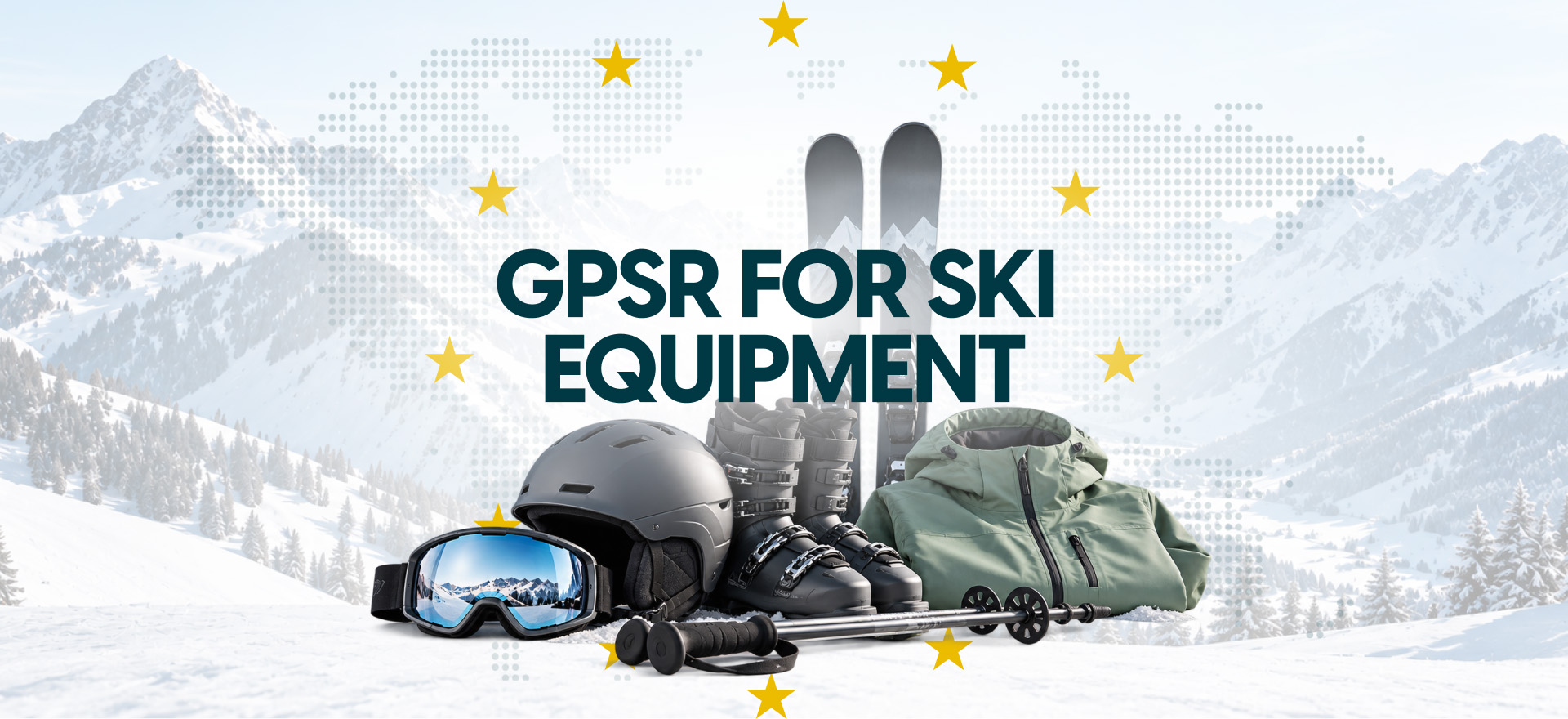
Ski equipment sold in the EU must meet the relevant product safety requirements, but a pair of skis doesn't follow the same regulatory route as a helmet or technical jacket.
Skis, poles and bindings generally fall under the General Product Safety Regulation (GPSR). Helmets and protective goggles are covered by specific personal protective equipment (PPE) rules, while ski clothing also needs to meet textile labelling and chemical safety requirements.
For ski brands, your challenge is identifying which legislation applies to each product and gathering the evidence needed to demonstrate compliance with EU safety requirements before entering the market.
How does GPSR apply to ski equipment?
The General Product Safety Regulation (EU) 2023/988 has applied since 13th December 2024, replacing the former General Product Safety Directive. It requires consumer products sold in the EU to be safe under normal and reasonably foreseeable conditions of use.
Ski equipment is exposed to cold, moisture, repeated impacts and wear. Manufacturers need to account for these conditions when assessing product safety, rather than relying solely on how equipment performs when new.
Article 9 of the General Product Safety Regulation sets out key obligations for manufacturers, helping ensure products are safe and traceable before reaching the EU market. These include carrying out an internal risk analysis, preparing technical documentation and providing the required product identification, manufacturer contact details and safety information.
Some ski products are covered by more specific EU legislation, such as the Personal Protective Equipment (PPE) Regulation. Where that legislation already addresses particular safety risks, the corresponding GPSR safety requirements do not apply to those risks. However, certain GPSR obligations may still apply where they are not covered by the product-specific legislation.
Which ski products are covered by GPSR?
Ski equipment is subject to different regulatory requirements depending on whether a product is intended for general use or designed to protect the wearer against specific hazards.
- Skis, bindings and poles: Generally covered by GPSR. Relevant risks include structural strength, durability and compatibility between bindings and ski boots.
- Ski helmets and protective goggles: Covered by the PPE Regulation (EU) 2016/425. These products require conformity assessment, technical documentation, an EU Declaration of Conformity and CE marking.
- Ski jackets, salopettes and base layers: Generally covered by GPSR, alongside applicable textile labelling and chemical safety rules. Clothing designed for ordinary weather protection is generally outside the scope of PPE legislation, while garments specifically designed to protect against extreme cold or other hazards may fall under the PPE Regulation.
- Ski bags and accessories: Usually covered by GPSR. Straps, fastenings and detachable components can present safety risks, particularly on products intended for children.
Ski helmets and goggles: where does GPSR apply?
Helmets and protective goggles are primarily regulated under the EU's PPE Regulation. As such, conformity requirements are more specific than those for ordinary ski equipment.
Recreational alpine ski helmets are typically Category II PPE. Manufacturers must arrange EU type-examination by a notified body, follow the required production conformity procedures and prepare an EU Declaration of Conformity before placing the product on the market.
For protective ski equipment, European standards provide a framework for assessing whether products meet relevant safety requirements. EN 1077 covers alpine ski helmets, including impact absorption and retention systems, while EN ISO 18527-1 addresses goggles used for downhill skiing and snowboarding.
For ski helmets, the PPE Regulation covers protective performance, including impact absorption and retention systems. However, certain GPSR provisions may still apply where these matters are not addressed by the PPE Regulation, including requirements relating to online product listings, accident reporting and product recalls.
Ski bindings: assessing safety under GPSR
Ski bindings must hold a boot securely during skiing while allowing it to release when necessary. If a binding releases unexpectedly, the skier can lose control. If it fails to release when needed, the risk of injury increases.
Release performance also depends on the boots being used, how the bindings are mounted and adjusted, and the condition of the equipment. These factors need to be considered together during a GPSR risk assessment.
Several ISO standards address the safety and compatibility of alpine skis, bindings and boots, including:
- ISO 9462: Safety requirements and test methods for alpine ski bindings, including release performance.
- ISO 11088: Assembly, adjustment and inspection of alpine ski, binding and boot systems.
- ISO 5355: Requirements and test methods for alpine ski-boot soles used with compatible binding systems.
- ISO 8364: Binding mounting areas on alpine skis.
Which standards apply depends on the binding and the equipment it's intended to work with. Manufacturers should check the relevant editions and use them to support the assessment where appropriate. Compliance with an ISO standard can provide valuable evidence of product safety, but does not automatically demonstrate compliance with every GPSR requirement.
Instructions also matter. Incorrect mounting or adjustment can affect how a binding releases, so users and technicians need clear information on boot compatibility, setup and maintenance.
Ski jackets and technical clothing: GPSR and other EU requirements
Most recreational ski jackets, salopettes and base layers fall under GPSR. Features such as drawstrings, fastenings and detachable parts may need particular attention, especially on children's clothing. EN 14682 provides safety requirements for cords and drawstrings on children's clothing, helping manufacturers assess potential entrapment hazards.
Textile composition and chemical safety are covered by separate EU rules. Regulation (EU) No 1007/2011 sets requirements for fibre composition labelling, while REACH Regulation (EC) No 1907/2006 restricts certain hazardous substances, including specific PFAS chemicals that may be used in waterproofing treatments.
Manufacturers need to account for the different textile components in a finished garment, as well as any coatings or treatments subject to chemical restrictions. Clothing specifically designed to protect against extreme cold or other significant hazards may also be classified as PPE, depending on its intended protective function.
What should a GPSR risk assessment for ski equipment include?
Your assessment needs to identify foreseeable hazards, consider how they could affect users and record the measures taken to reduce the risks.
Depending on the findings, a manufacturer might need to change a component, select a different material or carry out further testing. Where risks cannot be adequately addressed through design alone, instructions and warnings may be necessary.
Article 9 also sets requirements for the supporting technical documentation. This must include a general description of the product and its essential characteristics relevant to assessing safety. Where appropriate to the risks, it must also document the hazards identified, measures taken to eliminate or reduce those risks, and details of any relevant standards or other safety criteria applied. Supporting test reports should also be retained where testing has been used to demonstrate product safety.
The documentation must be kept up to date, made available to market surveillance authorities on request and retained for 10 years after the product is placed on the market.
Selling ski equipment online in the EU
Under Article 19 of GPSR, online offers for products within GPSR’s scope must include specified safety and identification information. This applies to product listings on websites and other distance-selling channels, not just the information supplied when an order arrives.
The offer must clearly display:
- The manufacturer's name or registered trade name, postal address and electronic contact address.
- Where the manufacturer is established outside the EU, the name, postal address and electronic contact address of the EU responsible person, as required under Article 16 of GPSR or Article 4 of Regulation (EU) 2019/1020, as applicable.
- A picture of the product, its type and any other product identifier.
- Any required warnings or safety information that must appear on the product, packaging or accompanying documents, in a language consumers can easily understand, as determined by the relevant Member State.
These online information requirements can also apply to ski helmets and protective goggles covered by the PPE Regulation, even though their product conformity requirements are governed by separate legislation.
Brands selling through retailers or marketplaces should make sure the necessary information is available for all online listings.
Manufacturers, importers, distributors and retailers: who is responsible for what?
GPSR obligations extend beyond the business that makes the equipment.
- Manufacturers are responsible for ensuring their products meet the relevant safety requirements before placing them on the EU market. For products within GPSR's scope, they must carry out an internal risk analysis, prepare technical documentation and provide the required product identification and safety information.
- Importers must verify that manufacturers have met the applicable safety and documentation requirements before placing products on the EU market. They must also provide their contact details, ensure storage and transport conditions do not compromise safety, and take appropriate action if a product is found to be dangerous.
- Distributors must check that the required product information is in place. They must not supply equipment they know, or have reason to believe, is non-compliant.
- Retailers generally have the obligations of distributors under GPSR. This includes checking required product information and ensuring storage and handling don't compromise safety. Online retailers must also meet the relevant requirements for product offers under Article 19.
Ski brands based outside the EU must also identify an economic operator established in the EU who can fulfil the applicable responsible-person requirements. Depending on the product and supply arrangements, this may be an EU importer, an authorised representative appointed through a written mandate, or a qualifying fulfilment service provider where no other eligible economic operator is established in the EU.
Read our complete guide to Authorised Representatives for EU & UK market compliance.
Need help with EU ski equipment compliance?
Not sure which requirements apply to your ski equipment, or whether you've got everything in place to sell in the EU?
Hooley Brown can help you work through the requirements for your products, from GPSR risk assessments and technical documentation to product labelling and EU responsible person services.
Get in touch with us to discuss your products and explore what support you need.
This article was published in November 2026. Regulations, standards and enforcement guidance can change. Requirements and provisional arrangements should be checked against the latest official guidance.