Rakes, hosepipes, pruning shears and wheelbarrows are all examples of gardening equipment that falls within the scope of EU product safety law.
Since 13th December 2024, the General Product Safety Regulation (GPSR) has tightened the rules around how consumer products are designed, documented, labelled and monitored across the European market.
GPSR compliance is now a legal requirement for businesses that manufacture, import, or distribute mechanical gardening equipment.
This blog post breaks down what GPSR regulation means for gardening products, which items are affected, and the steps each player in the supply chain must take to comply. We’ve also included a quick compliance checklist to help you track your progress.
What is GPSR, and how does it impact gardening equipment?
GPSR is the EU’s overarching framework for consumer product safety. It applies to any product placed or made available on the EU market that is intended for consumers, unless that product is already fully covered by sector-specific legislation.
Most mechanical gardening tools and accessories are not covered by product-specific EU directives. That means GPSR is the primary safety regulation governing these products.
GPSR sets out a general safety requirement and backs it up with detailed obligations around risk assessment, technical documentation, labelling, traceability and incident reporting.
Crucially, GPSR is a regulation rather than a directive, meaning it applies directly and uniformly across all EU member states.
Which gardening products are in scope?
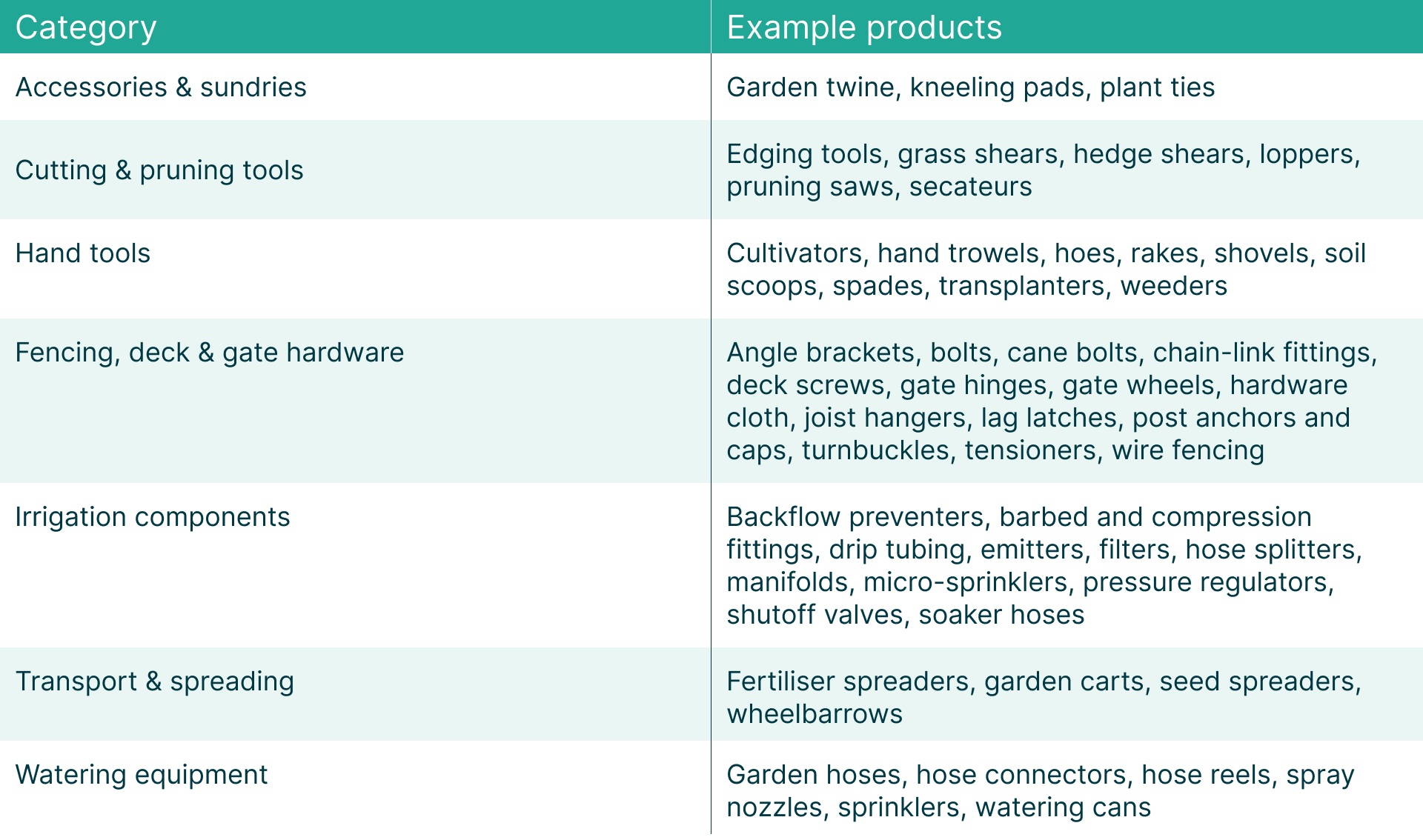
Any gardening product sold to EU consumers (whether new, used, repaired or reconditioned) is covered by GPSR rules. Here are the main product categories affected:
Gardening product categories covered by GPSR
Gardening products exempt from GPSR
Products designed exclusively for professional use are outside GPSR’s scope unless they have migrated to the consumer market. For example, if a professional-grade lopper is sold through a consumer retail channel or an online marketplace targeting end customers, it is subject to the regulation.
Key risks to assess for mechanical gardening products
GPSR requires manufacturers to carry out an internal risk analysis before placing a product on the market. The analysis must consider the product’s characteristics, its intended and reasonably foreseeable use, and the consumers likely to use it — including vulnerable groups such as children and older people.
For non-electrical gardening equipment, the principal risk categories include:
- Mechanical and physical hazards: sharp edges and blades on cutting tools, pinch points on folding mechanisms, breakage of components under load (e.g. wheelbarrow handles, rake tines), projectile risks from spring-loaded parts, and instability in carts or wheelbarrows.
- Chemical hazards: restricted substances in coatings, paints, rubberised grips or treated timber; potential compliance issues with metals, plasticisers or preservatives used in handles, fittings and hose materials.
- Ergonomic and strain-related hazards: poorly designed grips that contribute to repetitive strain, excessive weight or imbalanced loads, and inadequate sizing that leads to unsafe posture during use.
- Choking and ingestion risks: small detachable parts on accessories or tools that could be accessed by children, particularly in a domestic garden setting.
- Material degradation: UV degradation of hoses and plastic components, corrosion of metal parts, and fatigue failure in items subject to repeated stress.
- Water-system hazards: burst pressure failures in hoses and fittings, backflow contamination risks with irrigation components, and leaks from substandard connectors.
Your risk assessment should cover the entire product lifecycle, from first use through to disposal, and must be documented in the product’s technical file.
GPSR obligations by role in the supply chain
Understanding where your business sits in the supply chain is essential to determining exactly what is required to meet GPSR requirements.
Manufacturers
Manufacturers carry the heaviest compliance burden. Under GPSR, you must ensure every product has been designed and manufactured in accordance with the general safety requirement. Before placing a product on the market, you are required to:
- Carry out an internal risk analysis and compile technical documentation containing a general description of the product, its essential safety characteristics, an analysis of risks and the solutions adopted to mitigate them, plus a list of relevant European or national standards applied.
- Ensure the product bears a type, batch or serial number (or other unique identifier) that is easily visible and legible to consumers.
- Display your business name, registered trade name or trademark, and both postal and electronic contact details on the product, its packaging or an accompanying document.
- Provide clear instructions and safety information in a language easily understood by consumers in the Member State where the product is sold, unless the product can be used safely without them.
- Maintain technical documentation for at least 10 years after the product is placed on the market and make it available to market surveillance authorities upon request.
- Establish internal processes and procedures to ensure ongoing conformity for products produced in series.
- Notify authorities via the European Commission Safety Business Gateway if you become aware that a product is dangerous, and take corrective action, including withdrawal or recall as appropriate.
- Create publicly available communication channels (telephone, email or website section) for consumers to submit complaints and report accidents.
- Investigate complaints and maintain an internal register of complaints, recalls and corrective measures.
Importers
Importers are the gatekeepers for products entering the EU from other countries. Your core obligations include:
- Verifying that the manufacturer has completed a risk analysis, compiled the technical documentation, and applied the correct product identification and labelling before placing a product on the market.
- Displaying your own name, trade name or trademark and contact details on the product, its packaging or an accompanying document, without obscuring any information from the manufacturer.
- Ensuring products are accompanied by instructions and safety information in the appropriate language(s).
- Keeping a copy of technical documentation for at least 10 years and cooperating with the manufacturer and market surveillance authorities.
- Maintaining supply chain traceability records for at least six years, covering both your suppliers and customers.
- Taking immediate corrective action (including withdrawal or recall) if you become aware that a product you have imported is dangerous and notifying authorities through the Safety Business Gateway.
Distributors
Distributors are the last link in the chain before products reach consumers. While the obligations are lighter than for manufacturers or importers, they are still critical:
- Before making a product available on the market, verify that the manufacturer (and, where applicable, the importer) has applied the required product identification markings, business contact details and safety instructions.
- Ensure that storage and transport conditions do not compromise the product’s safety or its conformity with labelling requirements.
- Do not make a product available if you have reason to believe it is non-compliant or dangerous.
- If you identify a safety issue with a product already on the market, immediately inform the manufacturer or importer and notify the relevant authorities through the Safety Business Gateway.
- Keep supplier and customer records for traceability purposes.
EU Authorised Representative requirements
A key change introduced by GPSR is the requirement for a responsible economic operator in the EU for every product being sold.
If the manufacturer is based outside the EU, this role may be fulfilled by an importer, an authorised representative, or a fulfilment service provider. Their contact details must appear on the product, its packaging or accompanying documentation.
GPSR rules for online and distance sales
Products offered for sale online or through distance-selling channels are deemed to be made available on the EU market if the offer is targeted at EU consumers. GPSR requires every online product listing to clearly display:
- The manufacturer’s name, registered trade name or trademark, and their postal and electronic contact details.
- Where the manufacturer is not established in the EU, the name and contact details of the responsible person within the EU.
- Information enabling identification of the product, including a photograph, product type and any other identifiers.
- Any applicable warnings or safety information in a language easily understood by consumers in the target market.
Online marketplaces such as Amazon, eBay and specialist gardening platforms also have their own obligations under GPSR, including registering with the Safety Gate Portal, maintaining points of contact for authorities and consumers, and removing listings for dangerous products when notified.
GPSR technical documentation: what to include
The technical file is the cornerstone of GPSR compliance. For mechanical gardening equipment, the documentation should be proportionate to the product’s complexity and the risks identified. At a minimum, it should contain:
- A general description of the product and its essential safety-relevant characteristics.
- The internal risk analysis, covering all hazards identified across the product’s lifecycle (design, manufacture, use, reasonably foreseeable misuse and disposal).
- A description of the solutions taken to eliminate or mitigate the identified risks.
- Where applicable, testing reports and results.
- A list of relevant European standards, national standards or other elements applied to demonstrate conformity with the general safety requirement.
- Quality control procedures for series-produced products.
- Instructions for safe use and, where relevant, maintenance and disposal.
This documentation must be kept up to date and held available for market surveillance authorities for 10 years after the product has been placed on the market.
Other EU legislation to keep on your radar
GPSR does not operate in isolation. Depending on the nature of your gardening products, additional EU regulations may apply alongside it, including:
- REACH: governs the registration, evaluation, authorisation and restriction of chemicals. Relevant for any product containing coatings, paints, treated timber, rubberised or PVC components, or metal alloys that may contain restricted substances.
- Packaging and Packaging Waste Directive: sets requirements for the composition, reusability and recyclability of product packaging, and obligations around extended producer responsibility schemes.
- Machinery Regulation: while primarily covering powered equipment, certain manually operated machines (e.g. some types of manual hedge trimmers or post-hole diggers) may fall partially within its scope. Where the Machinery Regulation applies, GPSR covers any additional risks not addressed by it.
- EU Ecodesign and Energy Labelling regulations: increasingly relevant as the EU extends sustainability requirements to new product categories.
GPSR compliance checklist for gardening equipment
Use this checklist to track your compliance progress. The items are grouped by theme and are relevant across manufacturer, importer and distributor roles, though not every item will apply to every operator.
Risk assessment:
- Conduct an internal risk analysis covering all identified hazards
- Document risks across the full product lifecycle
- Consider risks to vulnerable consumers, particularly for products used in domestic gardens
- Reassess risks whenever the product design, materials or manufacturing process changes
Technical documentation:
- Compile a technical file containing a general product description, risk analysis, mitigation measures, test results and applicable standards
- Include safety testing records where relevant
- List all European or national standards applied, noting where only partial conformity has been achieved
- Establish a process to keep documentation up to date and retain it for a minimum of 10 years
Labelling & identification:
- Ensure every product bears a unique identifier that is visible and legible to consumers
- Display the manufacturer’s name, trade name or trademark and both postal and electronic contact details on the product or packaging
- For products manufactured outside the EU, display the responsible EU person’s name and contact details
- Provide clear instructions and safety information in the relevant local language(s)
Supply chain & traceability:
- Confirm that an EU responsible economic operator is identified for every product
- Ensure storage and transport conditions do not compromise product safety
- Maintain supplier and customer records for at least 10 years
Online & distance sales:
- Ensure all online product listings display manufacturer details, EU responsible person details, product identifiers and safety information
- Verify that online marketplace platforms you sell through have registered with the Safety Gate Portal
Incident response:
- Establish internal processes for reporting safety incidents through the Safety Business Gateway
- Set up publicly available communication channels for consumer complaints and accident reports
- Maintain an internal register of complaints, recalls and corrective measures taken
- Ensure processes are in place for rapid withdrawal or recall if a product is found to be dangerous
Intersecting legislation:
- Map all additional EU regulations applicable to your products
How Hooley Brown can help with gardening equipment compliance
Navigating GPSR can be complex, particularly for manufacturers based outside Europe or smaller businesses without a dedicated regulatory team.
Hooley Brown works with companies across the gardening equipment supply chain to simplify the compliance process and reduce regulatory risk.
Whether you need an EU Authorised Representative, want help pulling together your technical documentation, or a second pair of eyes on your labelling before a product launch, our compliance experts can assist.
We also support businesses with REACH compliance, packaging obligations and the broader regulatory picture, so you're not piecing it together across multiple advisers.
Book a free discovery call or contact hello@hooleybrown.com to discuss how we can support your gardening product compliance across the European Union.
This article was published in February 2026. Regulations can change. Always verify current requirements and seek professional advice for your specific situation.